—Barrington Williams, B1Daily
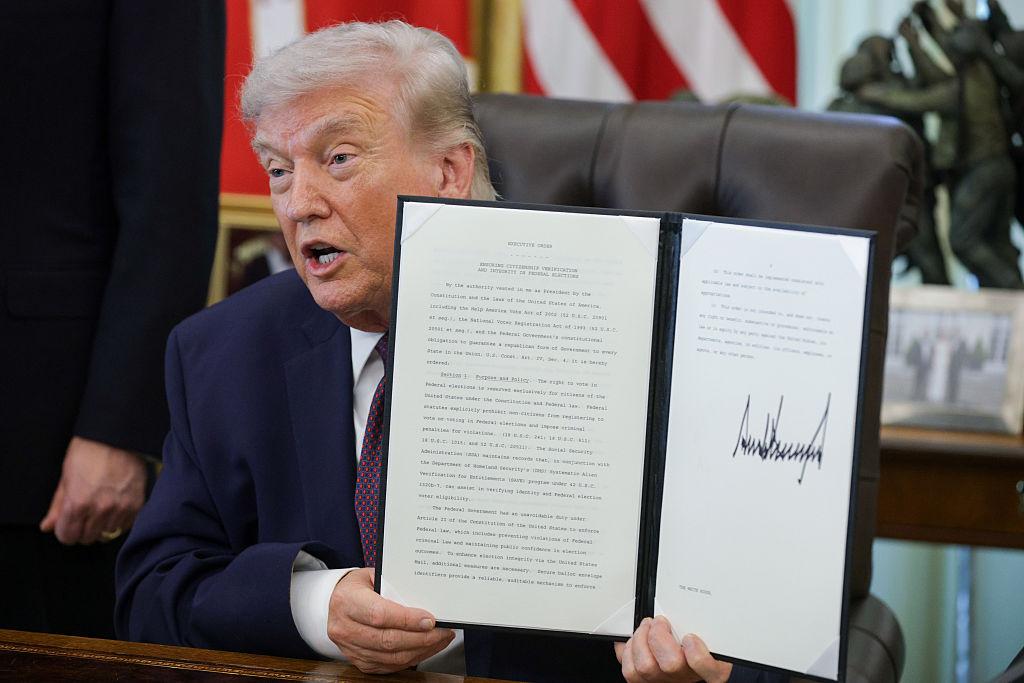
Donald Trump has returned to one of his favorite political villains: the mail ballot.
The president has repeatedly portrayed voting by mail as synonymous with cheating, argued that the practice is inherently corrupt and pushed the federal government toward new restrictions ahead of the 2026 midterm elections. The problem is the same one that haunted his accusations after the 2020 presidential election: the evidence does not support the sweeping claims.
Mail-ballot fraud can occur. So can fraud involving in-person voting. Election crimes should be investigated and prosecuted wherever credible evidence exists.
But isolated fraud is very different from demonstrating that America’s mail-voting system is systematically rigged or that widespread mail-ballot fraud has changed the outcome of a modern presidential election.
Trump has repeatedly blurred that distinction.
And Americans have seen where that road can lead.
Trump Is Back to Calling Mail Voting Cheating
Trump’s language in 2026 has been remarkably direct.
In March, he declared that “mail-in voting means mail-in cheating” while pushing lawmakers to restrict the practice. FactCheck.org reported in July that Trump described mail ballots as “inherently corrupt” while offering no evidence demonstrating widespread mail-ballot fraud.
Yet there is a spectacular contradiction buried inside Trump’s crusade.
Trump himself has voted by mail.
In March, records confirmed that he cast a mail ballot in a Florida special election. More recently, reporting indicated that Trump again used a mail ballot for Florida’s August Republican primary while continuing his campaign against the voting method.

Apparently, the ballot becomes considerably less suspicious when Donald Trump is the person mailing it.
The larger issue, however, isn’t hypocrisy.
It’s what Trump is teaching millions of Americans to believe about elections.
There Is Little Evidence for the Massive Fraud Trump Describes
Mail voting isn’t perfect. No voting system involving millions of human beings is.
But Trump’s rhetoric frequently leaps from the possibility of fraud to the assumption of mass corruption.
Those aren’t remotely the same thing.

An exhaustive Associated Press investigation after the 2020 election identified fewer than 475 potential voter-fraud cases across six battleground states. Biden’s combined victory margin across those states was more than 311,000 votes. The disputed cases amounted to only a tiny fraction of what would have been required to alter the result.
Trump’s own Justice Department couldn’t substantiate his larger allegations.
Then-Attorney General William Barr said the department had not uncovered fraud on a scale capable of changing the election outcome. Trump’s own Cybersecurity and Infrastructure Security Agency joined election officials in describing the 2020 election as the most secure in American history.
Courts didn’t rescue Trump’s argument either.
Trump and his allies filed dozens of lawsuits contesting the election. Again and again, judges rejected their attempts, including judges appointed by Trump himself.
That doesn’t mean voter fraud never happens.
It means extraordinary accusations require extraordinary evidence.
Trump never produced evidence remotely proportional to the extraordinary story he told America.
We’ve Seen This Strategy Before
This is where Trump’s renewed fixation becomes concerning.
Trump didn’t suddenly begin questioning mail ballots after he lost the 2020 election.
He attacked their legitimacy before Americans had even finished voting.
The House January 6 committee documented Trump’s pre-election campaign against mail voting, finding that he repeatedly warned supporters that mail ballots would produce a rigged election.
That mattered enormously because the pandemic produced a partisan divide in voting methods.
Democrats were considerably more likely to vote by mail, while Republicans were more likely to vote in person on Election Day.
Election analysts therefore warned Americans about a phenomenon sometimes called the “red mirage.”
Trump could appear ahead when the first Election Day votes were counted, only for Biden to gain ground as mail ballots were subsequently processed.
That wasn’t mysterious.
It wasn’t evidence of votes magically appearing.
It was arithmetic.
But Trump had spent months telling his supporters that mail ballots were suspicious.
When those perfectly predictable ballots began shifting the totals toward Biden, Trump already had a narrative waiting.
They are stealing the election.
The Allegation Came Before the Evidence
This is one of the most disturbing elements of the 2020 story.
Trump didn’t examine evidence of massive fraud and then conclude that the election had been stolen.
He repeatedly suggested beforehand that defeat itself could demonstrate fraud.
That reverses the normal burden of proof.
Instead of:
Here is evidence, therefore I believe cheating occurred.
The political logic becomes:
I lost, therefore somebody must have cheated.
Once supporters accept that premise, almost anything can become evidence.
A late-counted ballot becomes suspicious.
An election worker carrying ballot containers becomes suspicious.
A voting machine becomes suspicious.
A statistical anomaly becomes suspicious.
A Democratic city becomes suspicious.
An election official who refuses to overturn results becomes suspicious.
The conclusion becomes impossible to disprove because every piece of contrary evidence can simply be absorbed into the conspiracy.
Then Came January 6
The consequences weren’t confined to social media.
Trump continued insisting that the election had been stolen even after his own advisers, Justice Department officials, election administrators and courts rejected or failed to substantiate his central fraud allegations.
The January 6 committee concluded that Trump deliberately spread false fraud allegations while attempting to overturn the election and that those claims helped provoke his supporters to violence on January 6. Trump has rejected the committee’s conclusions and has long maintained that the election was stolen.
But the historical sequence matters.
First came months of warnings that mail voting would produce fraud.
Then came the election.
Then came claims that Trump’s defeat proved the warnings correct.
Then came lawsuits.
Then came pressure on state officials.
Then came efforts involving alternate electoral certificates.
Then came pressure on Vice President Mike Pence.
Finally, thousands of Trump supporters descended upon Washington on January 6, 2021, and a violent mob breached the U.S. Capitol as Congress was certifying Biden’s victory.
That doesn’t mean every person who questioned the election supported violence.
It doesn’t mean questioning election procedures is illegitimate.
It means repeatedly telling millions of people that their government has been stolen from them can have consequences.
People who genuinely believe democracy has been overthrown may eventually conclude that extraordinary action is justified to restore it.
January 6 demonstrated how dangerous that equation can become.
Now the Mail-Ballot Campaign Has Government Power Behind It
The difference between 2020 and 2026 is significant.
Trump isn’t merely a candidate complaining about election rules.
He’s president.
His administration has pursued restrictions on mail voting through executive action, producing a sprawling legal battle with states and voting-rights organizations.
On August 24, the Supreme Court allowed part of Trump’s executive order restricting mail voting to move forward while litigation continues. Importantly, the Court did not decide that Trump’s underlying fraud allegations were true, nor did it finally decide the legality of the policy itself. Its ruling centered on whether the states bringing that particular challenge had standing. Other litigation remains active.
Trump has also supported legislation imposing new voting requirements and has continued raising allegations of election irregularities as the midterms approach.
This transforms rhetoric into governing policy.
And it makes accuracy even more important.
Election Security Is Legitimate. Declaring Elections Corrupt Without Evidence Isn’t.
Republicans are perfectly entitled to demand secure elections.
Democrats should want secure elections too.
Voter rolls should be accurate.
Ballots should be protected.
Signatures and identification requirements established under law should be enforced.
Illegal voting should be prosecuted.
Election equipment should be audited.
Vote counting should be transparent.
Partisan observers should be permitted wherever state law allows them.
And election officials should be expected to explain irregularities rather than dismiss legitimate questions.
None of those principles requires pretending widespread mail-ballot fraud exists when evidence doesn’t demonstrate it.
Election security and election denial are not the same thing.
The first attempts to make elections trustworthy.
The second can destroy trust regardless of whether the election actually worked.
Trump Is Playing With Something Bigger Than His Own Political Future
America survived January 6.
That doesn’t mean the country should experiment with the conditions that helped produce it.
Presidents wield extraordinary influence over what their supporters believe. When a president repeatedly tells millions of citizens that elections are corrupt, those citizens don’t necessarily hear an abstract debate over election administration.
They hear something much darker:
Your vote doesn’t matter.
The system is rigged.
Your opponents are stealing your country.
That language raises the political temperature while simultaneously destroying confidence in the peaceful mechanism designed to resolve political disputes.
Trump has every right to advocate tighter election laws.
He has every right to oppose universal mail voting.
He has every right to demand investigations when credible evidence of fraud emerges.
But claims that elections are being stolen require proof.
The United States already conducted the experiment of allowing unsupported allegations about a stolen presidential election to metastasize through the political system.
It ended with shattered windows at the Capitol, lawmakers fleeing their chambers and Americans attacking police officers beneath banners bearing the name of the president they believed had been cheated.
That history makes Trump’s renewed obsession with mail ballots more than another partisan argument about election procedure.
America has already seen what can happen when allegations of election fraud become more powerful than the evidence behind them.
The country should be extremely reluctant to run that experiment twice.
—Barrington Williams, B1Daily



Leave a Reply