—Travis Luyindama, B1Daily
Artificial intelligence companies have discovered a new treasure chest for training their models: old-fashioned books.
Across the used-book industry, sellers have reported unusually large orders for older, obscure and academic titles. The reason is increasingly clear. Books contain something AI developers desperately want: professionally edited, long-form human writing produced before the internet became flooded with SEO sludge and AI-generated text.

But there’s an uncomfortable question hiding between those dusty pages:
What does the original author get out of this?
In many cases, potentially very little.
Buy the Book, Skip the Author
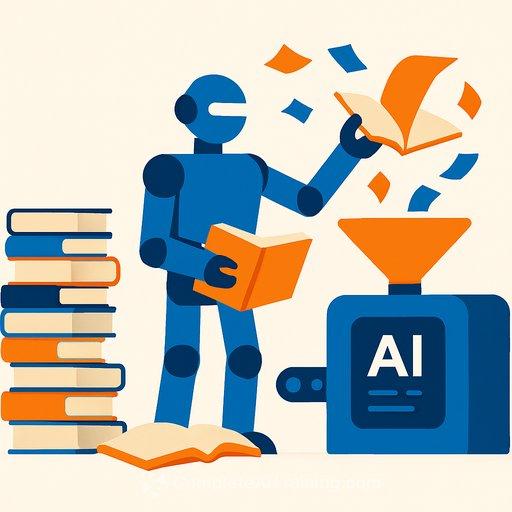
Court records revealed that Anthropic spent millions purchasing millions of physical books for a massive digitization effort known as Project Panama. Contractors removed bindings, cut pages, scanned the books into digital files and discarded the physical copies. A federal judge ruled that this particular process could qualify as fair use because the company purchased the physical books and maintained the resulting digital library internally.
That’s legally fascinating.
For writers, it’s also a little surreal.
Buying a used book normally doesn’t send another royalty payment to the person who wrote it. So an AI company can potentially buy an old copy from a reseller, transform its contents into valuable training material and use that material in developing commercial AI systems without separately paying or crediting the author.
The bookstore gets paid.
The shipping company gets paid.
The scanning contractor gets paid.
The technology company potentially builds a more capable product.
The writer whose words made the book valuable in the first place may receive nothing from that particular transaction.
The Machine Wants Human Writing
The irony is almost literary.
AI developers are hunting books precisely because books contain high-quality human writing. Court records showed Anthropic executives believed books could help models learn to write well rather than merely imitate lower-quality internet language.
Yet the humans responsible for producing that valuable language aren’t necessarily being individually credited every time their work contributes to a training corpus.
Meanwhile, booksellers have reported strange bulk purchases of titles that might otherwise sit untouched for years. Some stores suspect AI training operations because buyers appear unusually indifferent to subject matter or price.
The books have suddenly become valuable again.
Just not necessarily to their authors.
Copyright Law Hasn’t Caught Up
The legal picture is complicated. Courts have begun finding some forms of AI training to constitute fair use, while authors and publishers continue challenging other methods of acquiring and using copyrighted works. Anthropic also faced separate litigation over pirated digital books, demonstrating that how an AI company obtains a work can matter enormously.
But legality and fairness aren’t identical questions.
If books are valuable enough that billion-dollar AI companies are acquiring them by the truckload to improve commercial technology, society should seriously discuss whether authors deserve compensation, attribution or collective licensing mechanisms when their work becomes industrial-scale AI training material.
Because there is something backwards about building the writing machines of tomorrow by consuming the work of yesterday’s writers while leaving those writers invisible.
AI may be learning how to write from authors.
The least the industry can do is remember who taught it.
—Travis Luyindama, B1Daily






Leave a Reply