—Terrence Dorner, B1Daily
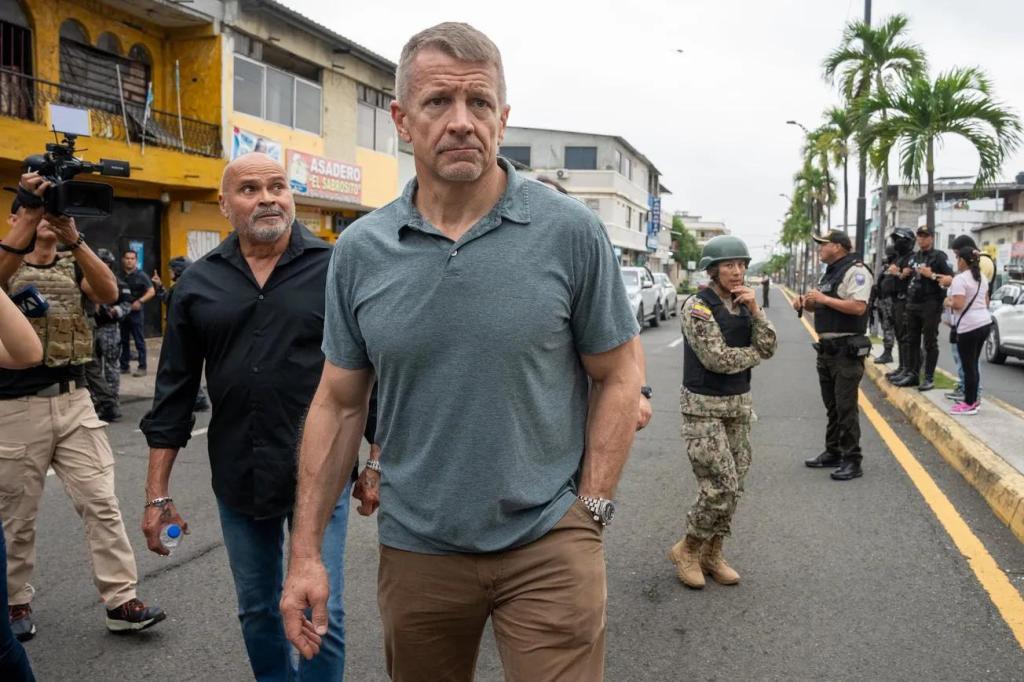
PORT-AU-PRINCE, HAITI | The man behind one of America’s most controversial private military companies has returned to the battlefield, and this time, his operations are unfolding in the Caribbean.

Erik Prince, the founder of Blackwater, has brought his private security operation to Haiti, deploying foreign personnel, armed drones, helicopters, and military expertise against the country’s powerful criminal gangs. But his involvement extends beyond fighting armed groups. His company also stands to benefit financially from Haiti’s customs revenue.
Technically, Blackwater itself has not invaded Haiti. Prince sold the company years ago, and the current operation belongs to his firm, Vectus Global, which entered Haiti under agreements with the Haitian government. Nevertheless, the operation has revived serious questions about foreign military contractors, civilian casualties, and whether a struggling nation is becoming dependent on private security forces.
From Baghdad to Port-au-Prince
Prince’s name remains inseparable from the 2007 Nisour Square massacre in Iraq, when Blackwater contractors killed Iraqi civilians in a shooting that resulted in four federal criminal convictions. President Donald Trump pardoned those contractors in 2020.
Prince himself was not convicted of those killings, but Blackwater’s history continues to influence scrutiny of his subsequent military ventures.
In March 2025, Vectus Global began operating in Haiti, supporting government security operations against heavily armed gangs. By August, Prince was publicly discussing plans to deploy hundreds of foreign personnel, including specialists in sniping, intelligence, communications, and aviation.
Haiti’s government sought outside assistance because criminal organizations had seized major transportation routes, attacked police facilities, and displaced enormous numbers of civilians. The country’s security crisis was real, and its police forces were badly overstretched.
Yet the arrival of a foreign private military operation raised a difficult question: What happens when a government increasingly depends on hired foreign fighters to exercise control over its own territory?
The Drone Campaign and Civilian Deaths
Vectus Global’s involvement has coincided with an aggressive campaign using explosive-equipped drones against suspected gang members.
According to Human Rights Watch, at least 1,243 people were killed in 141 drone operations between March 2025 and January 2026, including at least 43 adults reportedly unaffiliated with criminal groups and 17 children.
Those figures concern the broader Haitian government-linked drone campaign, not deaths individually established as the responsibility of Vectus personnel. Nevertheless, human rights investigators identified the company as supporting the task force responsible for the operations.
Human Rights Watch warned that some strikes appeared to constitute deliberate unlawful killings, while United Nations officials raised concerns about the use of lethal force in densely populated neighborhoods.
Prince’s defenders point to the brutality of Haiti’s gangs and the danger facing police officers and civilians. Those threats are substantial. But the presence of armed criminals does not eliminate the requirement to distinguish legitimate targets from innocent residents.
A Ten-Year Deal and Haiti’s Customs Revenue
Perhaps the most consequential part of Prince’s involvement has little to do with bullets or drones.
In 2025, Prince told Reuters that his company had reached a ten-year agreement involving the restoration of Haiti’s border customs and tax collection systems.
A September 2026 United Nations experts’ report subsequently described a ten-year border security and customs arrangement involving a company sharing leadership with the private security contractor. The company would receive a percentage of customs revenue.
The arrangement has generated concerns among Haitian stakeholders about national sovereignty and the amount of public revenue flowing to private interests.
This is where the military operation becomes an economic story. Haiti desperately needs stronger institutions, functioning roads, and dependable tax collection. But rebuilding those systems through contracts that financially reward foreign private operators raises questions about transparency, oversight, and long-term dependence.
The Mercenary Question: Security or Sovereignty?
In July 2026, Reuters reported that American security officials were considering closer cooperation with Prince’s company, even as human rights organizations raised concerns about civilian deaths.
An October 2026 CNN report provided rare footage of Prince’s personnel operating alongside Haitian police. The report showed helicopters transporting tactical teams and drones supporting security operations. Prince defended his company’s involvement, arguing that its capabilities helped prevent police from being overwhelmed by heavily armed gangs.
There have been some reported territorial gains. A United Nations investigation described security operations that recovered parts of Port-au-Prince, while warning that those gains could prove temporary without sustained policing, government services, and community stabilization.
The distinction is important. Private contractors may help clear neighborhoods of armed groups, but permanently restoring security requires functioning Haitian institutions.
Haiti’s Future Cannot Depend Entirely on Foreign Guns
Haiti has every right to seek international assistance against criminal organizations terrorizing its population. The gangs responsible for kidnappings, killings, sexual violence, and the destruction of public infrastructure represent a genuine national emergency.
However, military assistance and long-term dependence are not the same thing.
Prince’s operations highlight a dilemma facing Haiti’s government: Foreign contractors may offer immediate firepower, but their involvement also creates questions about civilian protection, contractual transparency, and democratic accountability.
The country’s future cannot be measured solely by the number of gang members killed or neighborhoods temporarily recaptured. Success must also mean rebuilding Haitian police capabilities, restoring courts, protecting civilians, and ensuring that public revenues serve the Haitian people.
Erik Prince may be selling Haiti a security solution, but the ultimate test is whether that solution strengthens Haitian sovereignty or leaves the country dependent on another foreign military enterprise.
—Terrence Dorner, B1Daily



Leave a Reply