—Sylvester Loving, B1Daily
Nigel Farage spent years selling Brexit as Britain’s great escape. Leave the European Union, take back control, reclaim sovereignty and watch the country stride confidently into a new age of prosperity.
Ten years after the referendum, Britain has had plenty of time to inspect the merchandise.
The packaging was considerably better than the product.
Brexit did not single-handedly cause every economic problem Britain faces. COVID-19, the energy shock, weak productivity growth and years of domestic policy failures all matter. But the emerging economic record makes it increasingly difficult to pretend leaving Britain’s largest trading relationship was some magnificent act of economic liberation.

A recent House of Commons Library review says the broad consensus among economists is that Brexit has left UK GDP smaller than it otherwise would have been, with studies estimating the loss at roughly 2 to 8 percent. It also notes that additional customs procedures and trade barriers have increased business costs and damaged trade and investment.
That’s quite a hangover from a party advertised as independence.
Farage Wasn’t a Bystander. He Helped Sell the Dream.
Farage cannot conveniently transform himself into a commentator observing Brexit’s shortcomings from a safe distance.

He spent decades campaigning for Britain to leave the European Union. Brexit was the political project that made him internationally famous.
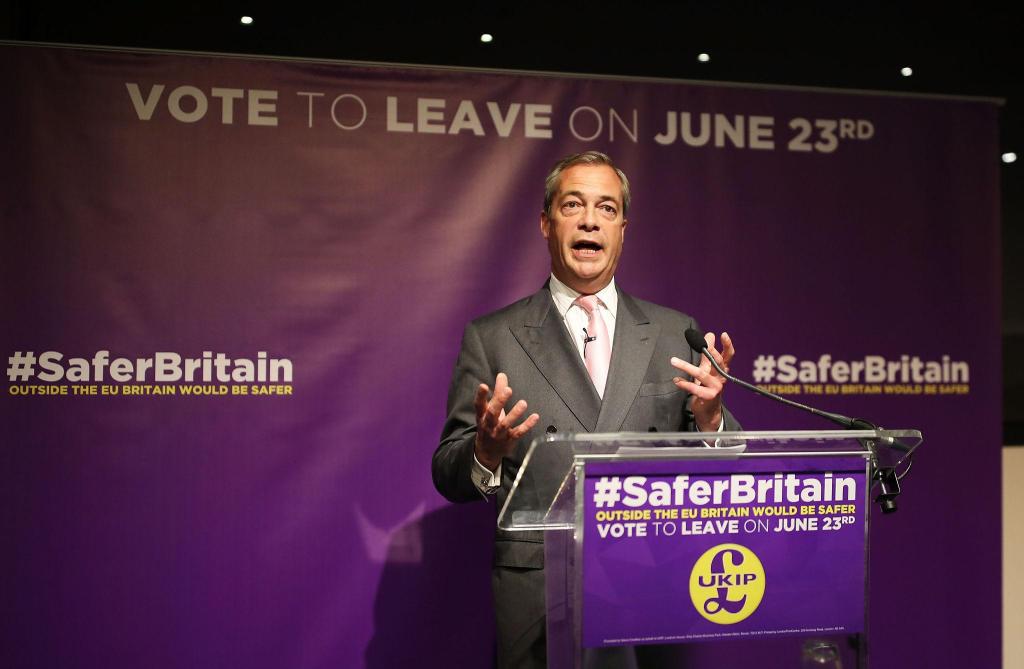
He relentlessly framed EU membership as a restraint on British sovereignty and immigration control. His 2016 campaign appearances explicitly argued that Britain would become safer outside the EU, with immigration becoming one of his central referendum issues.
Now that Brexit’s economic record is considerably less glamorous than the campaign rhetoric, Farage has frequently argued that Brexit itself wasn’t the problem. The politicians implementing it were.
What a magnificent political insurance policy.
Campaign for the revolution.
Celebrate when the revolution wins.

Then, when the results disappoint, announce that everyone else performed the revolution incorrectly.
“Take Back Control” Came With Paperwork
The Brexit campaign brilliantly reduced an extraordinarily complicated economic relationship to three seductive words:
Take back control.
But international trade isn’t a pub argument where sovereignty magically eliminates geography.
The European Union remains Britain’s enormous neighboring marketplace. Leaving its single market and customs union inevitably created new barriers for businesses trading across the Channel.
Exporters encountered additional declarations, regulatory requirements and border procedures. Smaller companies were particularly vulnerable because multinational corporations can hire compliance departments while a family-owned exporter cannot simply summon a customs bureaucracy from underneath the sofa.
The House of Commons Library’s 2026 assessment says economists broadly agree that Brexit adversely affected UK trade, particularly goods trade with the EU.
That isn’t Brussels punishing Britain for independence.
That’s what happens when you voluntarily place additional barriers between yourself and a major trading partner.
Where Is the Great Brexit Boom?
This should be the most uncomfortable question for Farage and the broader Leave movement.
Where is the transformational economic dividend?
Britain was promised freedom to negotiate its own trade agreements.
It got that freedom.
Britain was promised control over its own regulatory system.
It got greater control.
Britain formally left the EU.
Mission accomplished.
Yet supporters are still explaining why the spectacular economic benefits supposedly remain trapped somewhere over the horizon.
Meanwhile, the economic debate has shifted from whether Brexit produced a major boom to estimating how much poorer Britain is compared with the path it might have followed inside the EU. The Commons Library notes estimates ranging from a 2 percent to 8 percent GDP hit relative to remaining.
That is a brutal transformation of the original sales pitch.
Immigration Makes the Story Even More Absurd
Immigration was one of the most emotionally powerful weapons deployed by the Leave campaign.
Voters were told that leaving the EU would restore British control over immigration policy.
Technically, it did.
But ending EU free movement did not mean Britain suddenly stopped needing foreign workers. Instead, the composition of immigration changed substantially, with non-EU migration becoming increasingly important.
So Britain performed the political equivalent of ripping out the plumbing because it disliked the faucet.
The country gained greater legal control over immigration policy, certainly. But the fantasy that Brexit itself would automatically produce low immigration collided with Britain’s labor demands and subsequent decisions made by British governments.
Which exposes one of Brexit’s central contradictions.
Brussels could no longer be blamed for Britain’s immigration rules.
Britain finally had the control.
And controlling something turns out to be much harder than campaigning about it.
Brexit Became Britain’s Expensive Identity Crisis
4
The deeper damage wasn’t merely economic.
Brexit consumed British politics.
Prime ministers were devoured by it. Parliament became a battlefield. Conservatives fought Conservatives. Families fought families. Scotland and Northern Ireland reopened fundamental constitutional questions. Britain’s relationship with Europe became an exhausting national obsession.
And after all that political combustion, Britain still has to cooperate with Europe.
Of course it does.
France didn’t float into the Atlantic after Brexit.
Germany didn’t disappear.
European markets didn’t stop mattering.
Security cooperation didn’t become unnecessary.
Britain spent years dramatically divorcing its neighbors only to discover that the neighbors still lived next door.
Farage’s Greatest Talent Was Diagnosing Anger
Here is where Farage deserves some political credit, although probably not the kind he’d want.
He understood dissatisfaction.
He recognized that millions of Britons felt ignored by political elites. He understood anger surrounding immigration, declining industrial communities, stagnant wages and the perception that national institutions had become distant from ordinary citizens.
Those grievances weren’t imaginary.
But identifying legitimate anger does not automatically make your proposed cure effective.
Brexit offered voters a beautifully simple villain: Brussels.
Factories disappearing?
Brussels.
Immigration?
Brussels.
Bureaucracy?
Brussels.
Britain doesn’t feel like Britain anymore?
Brussels.
That simplicity was politically magnificent.
Economically, reality proved considerably less cooperative.
Britain’s deeper problems include chronic underinvestment, weak productivity, housing shortages, regional inequality, infrastructure problems and an aging population. Leaving the European Union couldn’t magically repair those structural weaknesses.
But it could create another set of trade barriers.
And it did.
The Brexit Movement Should Own Its Record
Farage remains a major force in British politics through Reform UK, which makes revisiting Brexit more than historical score-settling.
It is a question of political accountability.
If politicians want credit when their signature project succeeds, they should accept scrutiny when it disappoints.
Brexit supporters are perfectly entitled to argue that sovereignty itself was worth an economic cost. That is at least intellectually coherent. Nations sometimes accept economic sacrifices for political independence or democratic control.
But that’s substantially different from pretending there was no sacrifice.
The evidence increasingly indicates there was.
And the British public deserves politicians willing to acknowledge the trade-off rather than endlessly insisting that true Brexit has never been tried.
Britain Didn’t Need a Slogan. It Needed a Strategy.
Nigel Farage helped convince millions of people that Britain’s problems could be attacked by severing its political relationship with the European Union.
Britain severed it.
The structural problems remained.
Then Britain inherited new ones.
That is Brexit’s great political lesson.
Populism is extraordinarily good at identifying something people are angry about and turning that anger into a referendum.
Governing requires something considerably less exciting:
making the numbers work afterward.
Ten years later, Brexit’s defenders can still wave the Union Jack, celebrate sovereignty and insist Britain’s difficulties are somebody else’s fault.
But flags don’t increase productivity.
Slogans don’t eliminate customs barriers.
And “take back control” doesn’t pay an exporter’s paperwork bill.
Farage helped sell Britain one of the biggest political experiments in its modern history.
He doesn’t get to keep the applause from 2016 while sending everyone else the invoice.
—Sylvester Loving, B1Daily




Leave a Reply