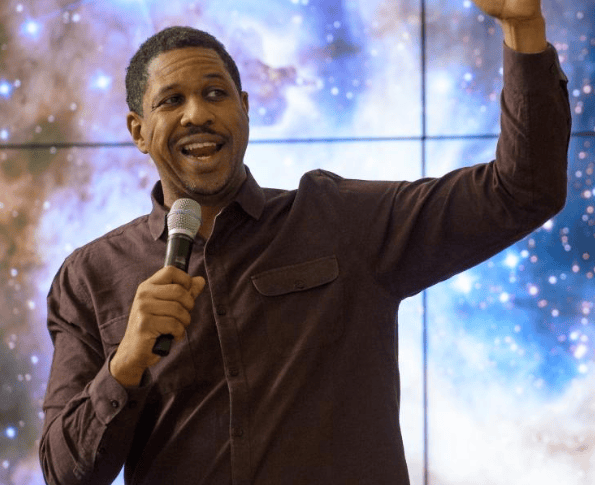
—Travis Luyindama, B1Daily
The universe is mostly invisible. Ordinary matter, the stuff that makes up stars, planets and people, accounts for only a small fraction of the cosmic inventory. Understanding everything else requires scientists willing to wrestle with some of physics’ most stubborn questions. Hakeem Oluseyi has spent much of his career working in that territory.
Oluseyi is an American astrophysicist, cosmologist, inventor and science educator whose research has stretched from the physics of the Sun to observational cosmology and the mysteries of dark matter and dark energy. He earned degrees in physics and mathematics from Tougaloo College before receiving his master’s degree and Ph.D. in physics from Stanford University. His scientific career has produced more than 100 publications spanning astrophysics, cosmology and plasma physics, alongside work developing space missions and astronomical observatories.
Chasing Dark Energy
One of Oluseyi’s most important connections to cosmology came through his work with the Supernova Cosmology Project, the collaboration whose research helped establish that the expansion of the universe is accelerating. Oluseyi worked on detector technology for a proposed space telescope designed to investigate the mysterious dark energy associated with that acceleration.

That distinction matters. Oluseyi did not originate the theory of dark energy, but his contribution belongs to the equally important experimental side of cosmology: developing instruments and methods capable of determining whether our theories about the universe actually match what is in the sky.
Dark energy remains one of modern physics’ largest unanswered questions. In the standard ΛCDM cosmological model, it is invoked to explain the universe’s accelerating expansion, yet its fundamental physical nature remains unknown.
Oluseyi’s work therefore sits at an interesting intersection between theory, instrumentation and observation. Instead of merely asking what dark energy might be, scientists in this branch of cosmology ask how precisely we can measure its effects.
Building the Machines That Test the Universe
Oluseyi also contributed to the development of the Large Synoptic Survey Telescope, now known as the Vera C. Rubin Observatory. His work included camera development and programs for analyzing the enormous quantities of astronomical data such surveys produce.
This is where modern cosmology becomes a cosmic detective story written in billions of data points. Large sky surveys allow researchers to examine supernovae, galaxies and other changing objects across enormous distances. Those observations can constrain models describing the universe’s expansion, structure and invisible components.
Oluseyi has described his research interests as extending into theories of both dark matter and dark energy, while his broader scientific work incorporates computational modeling, electromagnetic observations, machine learning, time-domain astronomy and large-scale data analysis.
From the Sun to the Entire Cosmos
His career is unusual because it refuses to stay neatly inside one astronomical box. His doctoral research focused heavily on the Sun’s atmosphere, while later projects moved outward toward stars, astronomical instrumentation and cosmology.
That range is significant because cosmology increasingly depends upon understanding individual astronomical objects with extraordinary precision. Stars and exploding stars can become measuring sticks for distances; galaxies reveal how cosmic structure developed; large surveys allow researchers to reconstruct how the universe changed over billions of years.
Oluseyi’s contribution is therefore better understood not as proposing one famous alternative cosmological model, but as helping build the observational machinery that allows cosmological theories to survive or die by evidence.
Today, he also serves as CEO of the Astronomical Society of the Pacific, combining research experience with science education and public communication. The organization notes that his career has ranged from solar astrophysics to investigations involving dark matter and dark energy.
Oluseyi’s story is a reminder that understanding the universe does not happen only when someone writes a new equation on a chalkboard. Sometimes progress comes from designing a better detector, building a more sensitive telescope, processing an ocean of observations, and asking nature whether our equations were right in the first place.
—Travis Luyindama, B1Daily





Leave a comment