—Michael Lyles, B1Daily
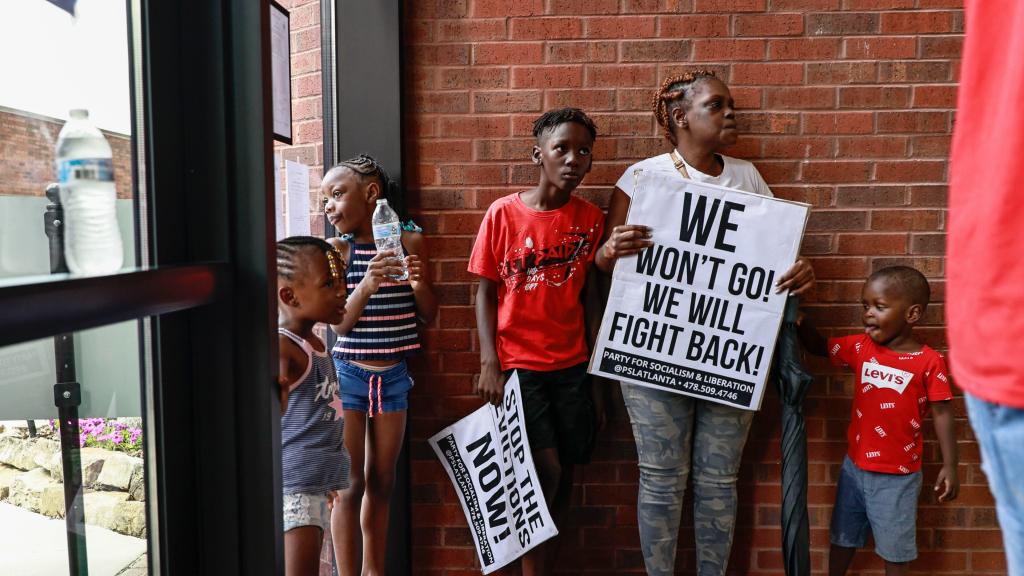
Atlanta may be one of America’s fastest-growing economic centers, but beneath its glittering skyline and booming real estate market lies a housing crisis threatening thousands of working-class families.
According to Princeton University’s Eviction Lab, landlords filed approximately 142,047 eviction cases across metro Atlanta between June 2025 and May 2026, equivalent to roughly one filing for every four renter households.
That staggering 24% filing rate was the highest among the metropolitan areas tracked by researchers, exposing an uncomfortable contradiction: Atlanta’s economy continues attracting investment while many residents struggle to keep a roof over their heads.
Importantly, these figures represent court filings, not completed evictions. Some landlords file repeatedly against the same households, meaning one in four renters were not necessarily physically evicted.
A Housing Crisis Three Times the National Average
Atlanta’s eviction filing rate is more than three times the roughly 7% national average reported in recent coverage of Eviction Lab’s findings.
The problem extends across Fulton, DeKalb, Clayton, Cobb, and Gwinnett counties, where rising housing expenses and financial instability have placed tremendous pressure on renters.
Researchers estimate that the region’s typical monthly rent is approximately $1,795. For workers earning $15 or $20 an hour, housing can consume an enormous portion of their income before utilities, transportation, groceries, and healthcare are even considered.
Meanwhile, Georgia’s relatively inexpensive eviction filing process allows landlords to initiate court proceedings for fees as low as approximately $54 to $75, depending on the county.
For tenants already living paycheck to paycheck, falling behind on rent can quickly become a legal and financial emergency.
Black Renters Are Bearing a Disproportionate Burden
The crisis is especially troubling for Atlanta’s Black population.
Eviction Lab data reported by WABE indicate that Black residents account for approximately 53% of renters in the city but experience about 69% of eviction filings.
This disparity raises serious questions about housing affordability, income inequality, neighborhood investment, and the long-term economic stability of Black households.
An eviction filing can create problems even when a family ultimately remains in its home. Court records may complicate future rental applications, while legal expenses and late fees can deepen financial insecurity.
For Black American families already confronting historical disparities in homeownership and household wealth, repeated housing instability can make saving for a down payment or building financial security substantially harder.
Atlanta’s reputation as a center of Black entrepreneurship and professional advancement means little to residents who cannot afford to remain in the communities they helped build.
When Eviction Becomes a Collection Strategy
Perhaps one of the most revealing findings concerns repeated eviction filings.
Researchers identified a 36% serial filing rate in metro Atlanta, meaning a substantial share of households facing eviction cases had been subjected to repeated filings at the same address.
Some landlords use the court system to pressure tenants into paying overdue rent, even when those tenants eventually settle their balances and remain housed.
Researchers also found that a relatively small number of properties accounted for a significant share of filings.
This raises a fundamental financial question: Should the eviction court system function as an aggressive rent-collection mechanism, particularly when tenants may be only days behind on payment?
Housing advocates have suggested reforms including longer grace periods, greater access to legal assistance, and stronger protections against unnecessary repeat filings.
Landlords also face legitimate financial obligations, including mortgages, property taxes, maintenance, and insurance. But those expenses do not eliminate the need for a fair process that distinguishes chronic nonpayment from temporary financial hardship.
Atlanta’s Economic Success Is Leaving Renters Behind
Atlanta’s housing emergency demonstrates that economic development does not automatically translate into economic security.
New construction, corporate investment, and rising property values can generate wealth for property owners while renters face escalating costs and limited opportunities to build equity.
The financial consequences extend beyond individual households. Housing instability can disrupt employment, children’s education, neighborhood businesses, and local consumer spending.
Preventing unnecessary displacement therefore isn’t simply a humanitarian concern. It’s an economic stability issue.
Atlanta needs a housing strategy that expands affordable rental supply, supports responsible property ownership, protects vulnerable tenants, and addresses the financial conditions driving repeated eviction filings.
A city cannot credibly celebrate prosperity while its rental housing system produces roughly one eviction case for every four renter households.
Atlanta’s eviction crisis is a warning about what happens when the cost of shelter outpaces the financial security of the people who keep a metropolitan economy running.
—Michael Lyles, B1Daily





Leave a Reply