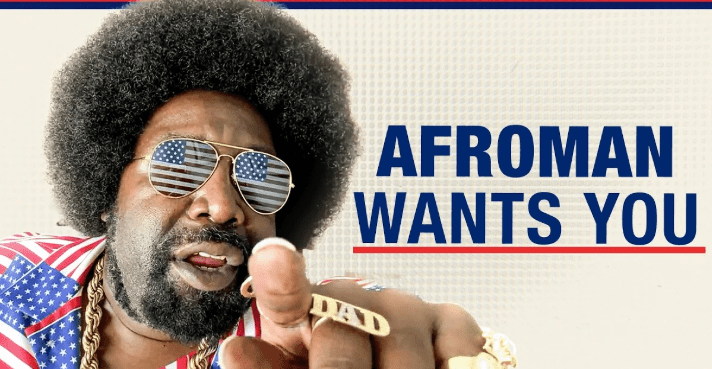
—Kerry Hill, B1Daily
In a political landscape that often feels scripted, the idea of Afroman stepping onto the 2028 presidential stage lands like an unexpected bass drop, offbeat, a little chaotic, and impossible to ignore. Best known for turning irreverence into chart-topping humor, Afroman has begun openly entertaining another run at the White House, and this time, the conversation around him feels less like a punchline and more like a signal.
This isn’t his first flirtation with politics. During the 2024 cycle, he filed paperwork and promoted a campaign steeped in satire but anchored in real issues, particularly around civil liberties and cannabis policy. What seemed like a novelty at the time has since evolved into something more textured. In interviews and appearances, he’s hinted at 2028 with a tone that walks a tightrope between performance and intent.
What’s driving the renewed interest isn’t just the man, it’s the mood.
Afroman’s appeal taps into a growing fatigue with polished political language and institutional gatekeeping. His style, blunt, comedic, and unapologetically raw, resonates with audiences who feel that public discourse has grown too filtered, too cautious, too rehearsed. In that sense, he’s less a traditional candidate and more a cultural counterweight, a reminder that political speech doesn’t have to sound like it came from a focus group.
Free speech advocates have taken particular notice.
While he’s not a policy wonk in the traditional sense, Afroman has consistently framed his messaging around expression, arguing that artists, citizens, and critics alike should be able to speak without fear of censorship or reprisal. That stance has earned him a niche but vocal following among those concerned about the boundaries of speech in the digital age, especially as platforms, governments, and corporations wrestle with where to draw the line.
There’s also a deeper layer to his appeal, one rooted in accessibility.
Afroman doesn’t present himself as a polished insider. He leans into the opposite, the everyday, the flawed, the unfiltered. For many supporters, that’s the point. In an era where political careers often feel pre-manufactured, his presence suggests that the barrier to entry might not be as rigid as it seems. Whether or not that perception holds up under the weight of a real campaign is another question entirely, but the inspiration it generates is undeniable.
Still, realism has to sit in the room.
A viable presidential campaign requires infrastructure, ballot access, funding, and a disciplined ground operation. As it stands, Afroman does not have the machinery of a major-party candidate, nor the broad coalition typically needed to compete at scale. His potential run, if it materializes, would likely operate on the fringes of the traditional system, more symbolic than competitive.
But symbolism has power.
In modern politics, where attention is currency and narrative shapes momentum, even an unconventional candidacy can shift the conversation. Afroman’s presence, serious or semi-serious, nudges debates about who gets to speak, who gets to run, and what political authenticity actually looks like.
So is he running?
Not yet in any formal, structured sense. But the idea is alive, drifting somewhere between a campaign plan and a cultural statement, gathering curiosity as it goes.
And in a political era defined by predictability fatigue, even that is enough to turn heads.
—Kerry Hill, B1Daily



Leave a comment