—Terrence Dorner, B1Daily
A hijacked cargo vessel being steered toward Somalia is more than a headline about maritime crime. It is a signal that control over key shipping lanes in the Horn of Africa is once again becoming unstable.
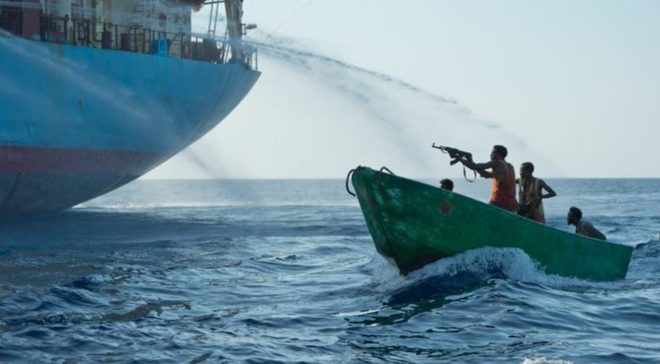
Reports indicate that suspected pirates boarded a commercial ship offshore, seized control, and redirected it toward the Somali coastline, effectively turning a civilian vessel into a moving asset under hostile command.
This is not random chaos. It is deliberate action carried out with operational intent.
Modern piracy in this region is no longer the improvised scramble often imagined in older narratives.
Boarding groups increasingly operate with coordination, timing, and familiarity with maritime routes. Once aboard, they are able to override navigation systems, restrict crew movement, and redirect ships toward coastal areas where recovery becomes significantly more difficult.
In this sense, the act is not simply theft but temporary control of a moving maritime platform.
The geography of the Horn of Africa plays a central role in why these incidents continue to emerge. The coastline is long, the maritime domain is difficult to patrol continuously, and commercial shipping routes pass through predictable corridors. This creates structural gaps in enforcement capacity. Even with international naval patrols, the scale of the sea far exceeds the ability of any single force to maintain constant coverage.
As a result, armed groups operating from coastal zones can exploit windows of opportunity when surveillance or response assets are not immediately present.
There is also a historical pattern at work. The region experienced a major wave of piracy during the late 2000s and early 2010s, which forced global shipping to adapt through convoy systems, armed escorts, and rerouting strategies.
Those measures reduced incidents for a time, but they did not eliminate the underlying conditions that allowed piracy to emerge in the first place. When attention shifted elsewhere and naval pressure eased, the environment became permissive again, allowing activity to reappear.
The economic consequences of even isolated incidents are significant. A single hijacking can raise insurance premiums across entire shipping corridors, disrupt cargo schedules, and force rerouting that increases fuel and operational costs.
The impact extends far beyond the immediate event, feeding into global supply chain instability. Maritime security, in this sense, is not just a regional issue but a structural component of international trade stability.
The strategic challenge is that maritime security success often creates cycles of complacency. When piracy declines, naval resources are redirected, patrol density decreases, and criminal networks regain space to operate.
What appears as a sudden resurgence is often the result of gradual reoccupation of neglected maritime zones. The current situation reflects that pattern, where non-state actors are testing the boundaries of enforcement once again.
Ultimately, the hijacked vessel drifting toward Somalia is not just an isolated incident. It reflects a broader shift in maritime dynamics where control over shipping routes is being contested again.
The sea does not signal these changes in advance. It simply begins to behave differently. And right now, the behavior suggests that the Horn of Africa maritime corridor is entering another period of instability.
—Terrence Dorner, B1Daily






Leave a comment