
—Kerry Hill, B1Daily
The United States is not running out of babies.
But it is having far fewer of them than it once did.
For decades, America maintained a birth rate high enough to sustain population growth and provide a steady stream of workers, taxpayers, entrepreneurs, and military recruits. Today, that picture is changing. Fertility rates have fallen well below the replacement level of approximately 2.1 children per woman, a threshold generally considered necessary to maintain a stable population without significant immigration.
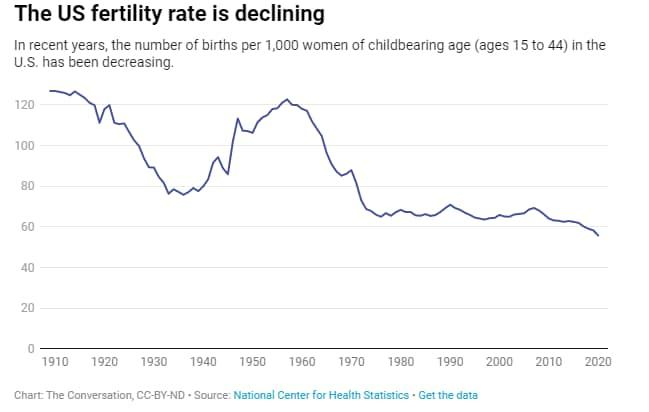
The consequences of this trend are beginning to concern economists, business leaders, military planners, and policymakers alike.
A nation is more than its borders, its natural resources, or its institutions. It is also its people. Every economy ultimately depends on a new generation entering the workforce to replace those who retire. When fewer children are born, fewer workers eventually enter factories, hospitals, schools, construction sites, technology firms, and military service.
The demographic challenge resembles a slow-moving iceberg. The effects are not immediately visible, but they become increasingly difficult to avoid over time.
One of the most immediate concerns involves the labor force. America’s economic growth has historically been powered by a combination of productivity gains and population growth. If population growth slows significantly, businesses may face increasing difficulties finding workers. Industries already experiencing labor shortages, such as healthcare, manufacturing, transportation, and skilled trades, could encounter even greater challenges in the decades ahead.
Government finances may also come under pressure.
Programs such as Social Security and Medicare were built on the assumption that a large working-age population would support a smaller retired population. As birth rates decline and life expectancy remains relatively high, the ratio of workers to retirees shrinks. Fewer workers supporting more retirees creates financial strains that lawmakers will eventually have to address.
The military faces similar concerns.
Modern armed forces depend on a healthy pool of eligible recruits. Military leaders have already reported recruitment challenges in recent years. A smaller youth population could make it even more difficult to maintain force levels in the future, especially if eligibility rates continue to decline due to health, education, or fitness issues.
Housing markets, schools, and local economies could also feel the effects. Communities that experience population stagnation often see reduced consumer spending, slower business growth, and challenges maintaining public services. Some regions may prosper despite demographic decline, but others could face long-term economic headwinds.
Why are Americans having fewer children?
The answers are complex. Rising housing costs, student debt, childcare expenses, delayed marriage, economic uncertainty, career pressures, and changing cultural attitudes toward family all play a role. For many young adults, the financial barriers associated with raising children appear higher than they did for previous generations.
At the same time, some analysts argue that declining birth rates are not entirely negative. Smaller populations can reduce pressure on infrastructure, lower environmental impacts, and potentially increase investment per child. The challenge lies in balancing those benefits against the economic realities of an aging society.
The debate over solutions is likely to intensify. Some policymakers advocate expanded child tax credits, affordable childcare programs, housing reforms, or family-friendly workplace policies. Others argue that economic growth and lower living costs would naturally encourage family formation without government intervention.
Regardless of the policy approach, the demographic trend is becoming increasingly difficult to ignore.
America is not headed toward a birth rate of zero. Millions of children will continue to be born every year. But if fertility rates remain well below replacement levels, the nation may face a future defined by slower population growth, an older workforce, increased fiscal pressure, and difficult economic choices.
The question facing the country is no longer whether birth rates are falling.
The question is whether America can adapt before the demographic consequences become impossible to ignore.
—Kerry Hill, B1Daily





Leave a comment