—Pratima Gadal, B1Daily
Indonesia’s political establishment has a problem that riot shields cannot solve.
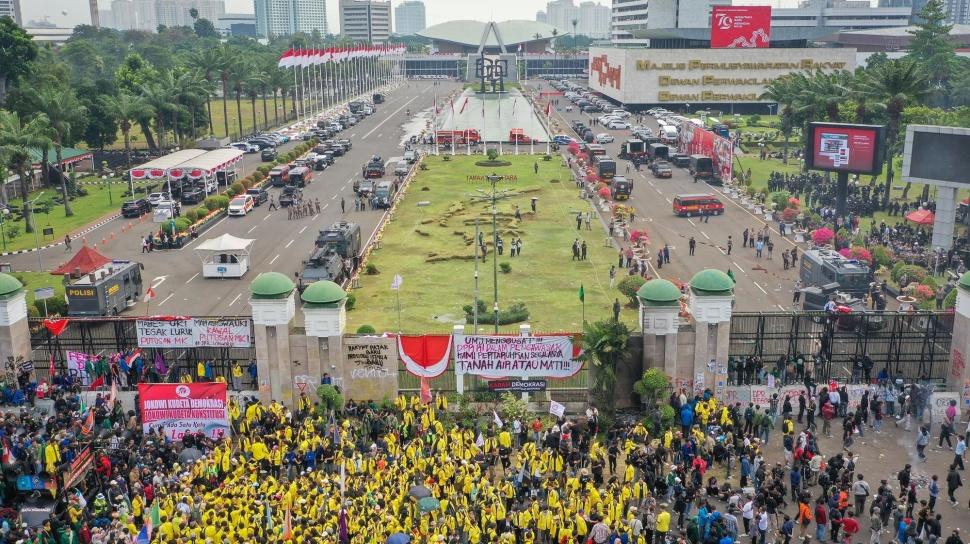
Thousands of citizens descended on the country’s parliament in Jakarta on August 27 demanding tougher action against corruption, including passage of a long-delayed law that would allow the government to seize assets connected to graft and other economic crimes.

But beneath the banners and chants sits something considerably more dangerous for Indonesia’s political class:
People increasingly believe corruption is making ordinary citizens poorer while politically connected Indonesians get richer.
The protesters didn’t whisper that accusation.
One banner outside parliament delivered it plainly:
“The corrupt get rich while the people suffer.”
That sentence may explain the political danger facing President Prabowo Subianto better than any polling memo.
They Want the Money Back
At the center of the demonstrations is Indonesia’s proposed Asset Forfeiture Bill.
Versions of the legislation have been discussed since 2008.
Eighteen years later, protesters are still waiting.
The measure would strengthen the government’s ability to trace, freeze, seize and confiscate assets connected to corruption and other economic crimes. Parliament is currently considering the legislation, with lawmakers aiming for passage by December.
For protesters, imprisonment alone isn’t enough.

Their argument is straightforward: if politicians or officials steal public money, the government should take the proceeds back.
Some demonstrators went dramatically further, demanding the death penalty for people convicted of corruption.
That demand demonstrates just how toxic the issue has become.
Corruption isn’t being treated merely as white-collar crime.
It is increasingly being portrayed as theft from an entire society.
Economic Pain Is Feeding the Anger
This isn’t happening in an economic vacuum.
Indonesia is Southeast Asia’s largest economy, but ordinary citizens are confronting concerns over food prices, inequality and the cost of living.
Protesters included students, workers, motorcycle taxi drivers and activists.
Their grievances stretched beyond corruption.
Some demanded lower prices for basic necessities.
Others demanded stronger labor protections.
Students criticized President Prabowo’s signature free school meal program, which has faced allegations of corruption and repeated food-poisoning incidents.
That connection is politically explosive.
A corruption scandal becomes considerably more dangerous when citizens begin connecting stolen government money with the price of groceries, wages and deteriorating public services.
The argument stops being:
Politicians are corrupt.
It becomes:
Politicians are corrupt, and we’re paying for it.
Governments should fear the second sentence considerably more.
Eighteen Thousand Police Officers
Jakarta authorities deployed approximately 18,500 security personnel as demonstrators converged around parliament.
Police kept protesters behind the legislature’s gates for much of the demonstration.
Later, tensions escalated.
Objects were thrown.
Police responded with tear gas and water cannons.
A police post and motorcycles were set on fire.
The unrest subsequently grew more serious. Authorities said more than 300 people were detained following late-night disturbances, including 160 minors, while dozens were named as suspects in connection with vandalism and violence.
Authorities said the main demonstration had largely dispersed before another group remained and engaged in rioting.
That distinction matters.
Thousands of people demanding political reform should not automatically be conflated with individuals accused of committing violence afterward.
But the disorder demonstrates how combustible the political environment has become.
Indonesia Has Seen This Movie Before
The date of the protest was deliberately chosen.
August 27 marked one year since massive anti-government demonstrations erupted in 2025.
Those protests eventually descended into riots.
People died.
Thousands were arrested.
The demonstrations became one of the earliest major tests of Prabowo’s presidency.
Now Indonesians are back outside parliament.
That should concern the government.
One protest can be dismissed as an eruption.
Repeated protests become a political pattern.
And political patterns eventually become movements.
Corruption Is Becoming an Economic Issue
Indonesia’s struggle offers a larger lesson far beyond Southeast Asia.
Governments frequently treat corruption as an abstract institutional problem.
Create an anticorruption commission.
Pass ethics regulations.
Prosecute a few officials.
Promise transparency.
Move along.
Citizens experience corruption differently.
When government money disappears, somebody pays.
Infrastructure isn’t built.
Schools aren’t properly funded.
Taxes rise.
Public services deteriorate.
Government contracts become more expensive.
Businesses connected to political insiders receive advantages unavailable to competitors.
And ordinary citizens begin wondering why they are being told the government cannot afford something while officials accused of corruption somehow accumulate extraordinary wealth.
That is why asset forfeiture has become such a powerful symbol for Indonesian protesters.
They don’t merely want corrupt officials punished.
They want the money returned.
The Pati Connection Makes the Story Even Better
One of the major groups behind the protest, the United Pati Community Alliance, emerged from a local political uprising in Central Java.
In 2025, residents of Pati Regency erupted after local authorities proposed increasing land and building taxes by as much as 250 percent.
The official at the center of that controversy, Regent Sudewo, was later detained by Indonesia’s Corruption Eradication Commission in an unrelated corruption investigation.
Now protesters from Pati have carried their campaign directly to the national parliament.
That sequence practically writes its own political message:
Citizens were told to pay dramatically higher taxes.
Then the politician demanding them became entangled in corruption allegations.
Nothing destroys trust in government faster.
Parliament Has Been Given a Deadline
Protest organizers say lawmakers have promised movement on the Asset Forfeiture Bill.
Representatives of the United Pati Community Alliance met lawmakers outside parliament, and the group’s leader says some legislators promised to resign if the legislation isn’t passed by December 15.
The protesters have effectively placed a clock over parliament.
If lawmakers deliver, the demonstrations may have accomplished something substantial.
If lawmakers stall again, Indonesia could discover that the crowds outside parliament were merely the opening act.
Because after eighteen years of waiting, protesters aren’t demanding another committee.
They aren’t asking for another anticorruption speech.
They want the state to take stolen wealth away from people who stole it.
The Political Class Should Read the Banner
Indonesia’s political establishment should pay attention to the language appearing outside parliament.
Not because every demand from the demonstrations is reasonable. Calls for executions should raise serious concerns about proportional punishment, due process and human rights.
But the central anger cannot be dismissed.
People increasingly believe corruption has created an economy where ordinary citizens shoulder rising costs while politically connected elites accumulate wealth.
Once that belief becomes widespread, corruption stops being merely a criminal-justice issue.
It becomes a legitimacy crisis.
Indonesia still has an opportunity to demonstrate that democratic institutions can respond.
Pass credible anticorruption legislation.
Recover stolen assets through due process.
Strengthen independent investigators.
Make government contracting transparent.
Prosecute corruption regardless of political affiliation.
And show citizens where recovered money goes.
Otherwise, those locked gates outside parliament may become a recurring feature of Indonesian politics.
Because the most dangerous moment for a corrupt political system isn’t when citizens discover corruption exists.
Everyone already knows corruption exists.
The dangerous moment comes when citizens decide they are personally paying the bill for it.
—Pratima Gadal, B1Daily




Leave a Reply