—Sylvester Loving, B1Daily
There is a particularly disturbing thread connecting the European conquest of the Americas, American slavery and the concentration camps of Nazi Germany: powerful institutions repeatedly discovered that dogs could be transformed from human companions into instruments of terror.
The breeds changed. The governments changed. The victims changed.
The underlying strategy was frighteningly familiar.
Train an animal to chase people whom the ruling system has declared inferior, dangerous or disposable. Give the dog to soldiers, slave catchers or guards. Then allow its superior speed, senses and physical power to extend human authority into places where a fugitive might otherwise escape.
Dogs did not create racism. Human beings trained them to enforce it.
The Conquistadors’ Four-Legged Weapons
The story reaches deep into the European conquest of the Americas.
Spanish conquistadors brought European war dogs into campaigns against Indigenous populations beginning in the earliest years of colonization. Historian Alfredo Bueno Jiménez traces their military use in Hispaniola to the campaigns of the 1490s, after which dogs appeared alongside Spanish forces elsewhere in the Americas.
These were not modern Bullmastiffs. Historical accounts instead describe mastiff-type dogs, Spanish Alanos and large hunting or war dogs known as lebreles.
And they could become terrifying weapons.
Dogs accompanied conquistadors including Juan Ponce de León, Hernán Cortés, Francisco Pizarro and Hernando de Soto. Historical research describes dogs being used not simply during combat, but eventually as instruments of punishment and execution against Indigenous people.
Some even became famous.
Becerrillo, associated with Ponce de León’s campaigns in Puerto Rico, became legendary among Spanish forces. His son Leoncico accompanied Vasco Núñez de Balboa. Contemporary Spanish chroniclers celebrated such animals almost as fellow soldiers.
But from the perspective of the people being conquered, these animals represented something very different: European military power equipped with teeth.
Research on the early Spanish Caribbean describes instances in which Indigenous prisoners were subjected to dogs as punishment. One particularly gruesome account describes Indigenous leaders being attacked and ultimately torn apart by trained dogs during the colonial conquest.
The dog had become more than an animal.
It had become an extension of colonial authority.
From Hunting Indigenous People to Hunting Enslaved Black People
The tactic did not disappear.
It evolved.
As European slavery expanded throughout the Americas, dogs became an extraordinarily effective method of pursuing escaped enslaved Africans.
Historian Tyler D. Parry and Charlton W. Yingling document an interconnected culture of slave hunting involving Cuba, Jamaica, Haiti and the American South. Dogs were trained to locate, pursue, intimidate and sometimes attack Black fugitives.
The infamous Cuban bloodhound became particularly associated with this system.
These animals combined characteristics prized by slave hunters: tracking ability, endurance, speed and physical intimidation. By the nineteenth century, specialized dogs and handlers were part of the machinery used to capture people attempting to escape slavery.
The business became so normalized that American newspapers advertised slave hunters boasting about their dogs for catching Black fugitives.
Think about the horror contained inside that sentence.
Human beings were breeding and training animals specifically to hunt other human beings because those people had attempted to escape bondage.
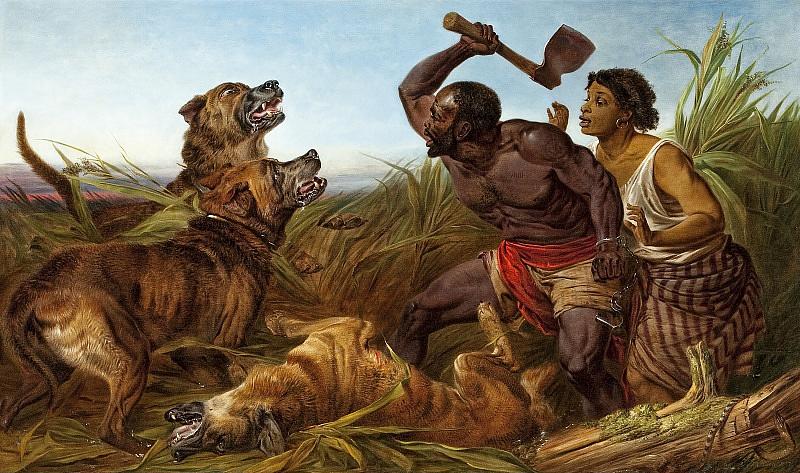
The Smithsonian’s National Museum of African American History and Culture preserves The Hunted Slaves, an 1862 painting by Richard Ansdell depicting an escaped Black man and woman fighting off attacking mastiff dogs in a marsh. The man still has broken shackles hanging from his wrist.
It captures something statistics cannot.
Freedom was close enough to run toward, yet slavery could literally chase you through the wilderness.
Dogs Extended the Reach of Slavery
That was precisely why these animals were so valuable to slaveholders.
A human patrol had limitations.
A fugitive could disappear into forests, mountains or swamps. Darkness provided concealment. Distance provided protection.
A trained tracking dog changed the equation.
Its nose could follow trails invisible to human beings. Its speed could overwhelm someone traveling on foot. Its barking could alert armed pursuers. Its teeth provided another layer of violence once the fugitive was cornered.
Dogs effectively allowed slaveholding societies to project their authority beyond the plantation.
Research into slave hounds describes Black fugitives developing countermeasures. Escapees traveled through water, attempted to confuse scents, hid in difficult terrain and sometimes fought the animals when escape became impossible.
The hunted learned how to fight the hunter.
Nazi Germany Industrialized Canine Terror
Centuries later, dogs appeared inside another system constructed around racial hierarchy, forced labor and mass imprisonment.
Nazi Germany.
The SS used guard dogs throughout the concentration-camp system. German Shepherds became particularly associated with Nazi military and security forces, although they were not the only dogs employed.
At Buchenwald concentration camp, the SS maintained dedicated kennels and organized a dog brigade. The surviving kennel complex stands today as physical evidence of how systematically dogs were incorporated into camp security.
These animals were not decorative guards.
The Buchenwald Memorial describes them as another SS weapon and a continuing source of terror for prisoners.
Dogs guarded inmates working outside the camp. They were deployed when prisoners escaped. They could even be unleashed against newly arriving prisoners. In late 1942, much of Buchenwald’s dog brigade was transferred to Auschwitz to help train and deploy guard dogs there.
This occurred within a concentration-camp system where Jews, Roma, political prisoners, Soviet prisoners of war, homosexuals, disabled people and numerous other groups were subjected to imprisonment, forced labor, brutality and murder under Nazi rule. The Nazis eventually constructed a network numbering tens of thousands of camps and related incarceration sites across Europe.
Once again, the dog became an extension of human ideology.
The animal did not understand antisemitism.
It understood commands.
The Animal Was Never the Monster
That distinction matters.
There is nothing inherently racist about a German Shepherd, bloodhound, mastiff or any other dog involved in these histories.
The cruelty belonged to the people holding the leash.
Spanish conquistadors weaponized dogs against Indigenous populations because colonial authorities considered those populations obstacles to conquest.
Slaveholders and slave catchers trained dogs to pursue Black people because slavery defined human beings as property that could be recovered.
The SS trained dogs to terrorize concentration-camp prisoners because Nazi ideology had stripped millions of people of their rights and humanity.
Across dramatically different historical periods, the dog performed a similar political function: it expanded the physical reach of the oppressor.
A forest stopped being sanctuary when a bloodhound could follow your scent.
Distance stopped guaranteeing safety when trained dogs could outrun you.
A concentration-camp perimeter became even more terrifying when crossing it meant confronting animals trained to pursue prisoners.
The leash therefore becomes an uncomfortable historical symbol.
At one end was an animal conditioned to obey.
At the other was a human being who had decided who deserved to be hunted.
From Conquest to Slavery to Genocide
These histories should not be collapsed into a claim that Spanish colonialism, American slavery and Nazi Germany were identical systems. They were not.
But history does reveal recurring technologies of domination.
Chains restrained people.
Walls confined them.
Weapons threatened them.
And dogs hunted them.
In the Americas, European colonizers demonstrated how trained dogs could help conquer Indigenous populations. Slave societies refined canine pursuit into a specialized method for capturing Black fugitives. Nazi concentration camps later incorporated trained guard dogs into an enormous apparatus of imprisonment and terror.
Different centuries. Different regimes. Different victims.
But the same chilling transformation took place each time.
Human beings looked at one of humanity’s oldest companion animals and asked not how it could protect people, but how effectively it could hunt the people they wanted to control.
The darkest part of this history was never the teeth.
It was the hand giving the command.
—Sylvester Loving, B1Daily






Leave a Reply