—Terrence Dorner, B1Daily
After decades of upgrades, added armor and new electronics, the U.S. Army’s legendary M2 Bradley Fighting Vehicle is finally staring at a potential successor in the flesh.

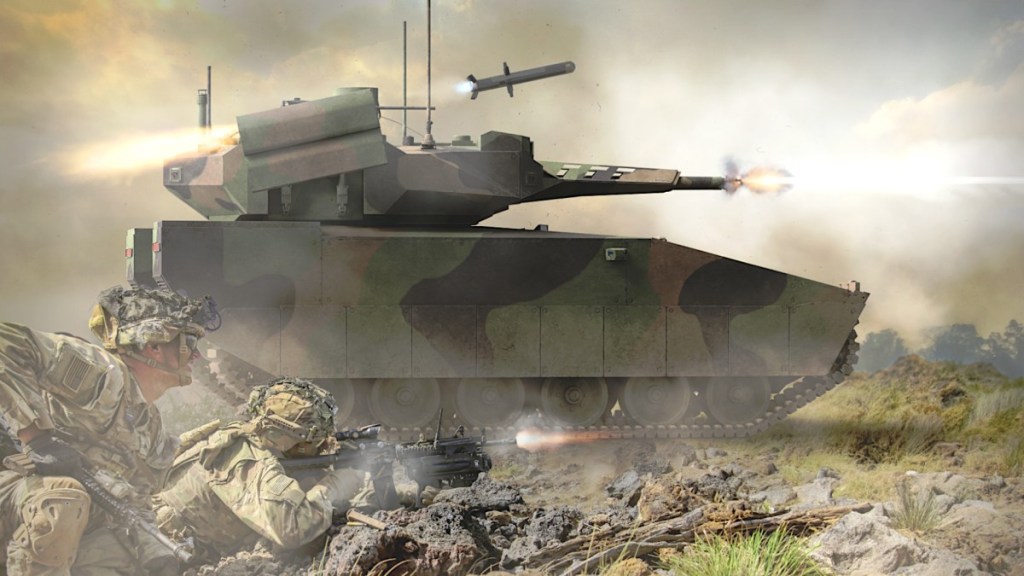
American Rheinmetall has delivered its first Lynx XM30 prototype to the Army, moving the long-running Bradley replacement effort from digital designs and promises into the far more unforgiving world of actual military testing. Seven additional Rheinmetall prototypes are scheduled for delivery later in 2026.
The delivery represents a major milestone for a program that could determine what American mechanized infantry rides into battle for decades.
The Bradley Has Been Stretched About as Far as It Can Go

The Bradley entered Army service in the early 1980s and has evolved dramatically since then. Improved armor, sensors, electronics and weapons have kept it relevant through the Gulf War, Iraq and today’s battlefield in Ukraine.
But there is only so much new technology that can be bolted onto a vehicle whose basic architecture dates back more than four decades.
The Army wants the XM30 to provide greater lethality and survivability while incorporating robotics and autonomous or semi-autonomous systems. The Pentagon specifically describes the XM30 as the future replacement for the M2A4 Bradley in Armored Brigade Combat Teams.
And the battlefield the XM30 is being designed for looks radically different from the one that produced the Bradley.
Drones swarm overhead. Electronic warfare attacks communications. Precision weapons can strike armored vehicles from miles away. Sensors are everywhere.
The next American infantry fighting vehicle must therefore be more than a heavily armored troop carrier with a cannon.
It needs to become a rolling digital combat system.
Rheinmetall’s Lynx Brings Some Serious Technology
Rheinmetall’s answer is based on its existing Lynx KF41 family but heavily adapted for the Army’s XM30 requirements.
One of its most interesting features is a hybrid-electric powertrain combining conventional and electric power. Rheinmetall says the additional electrical capacity should help support the enormous appetite modern military vehicles have for sensors, communications equipment and future electronic systems.

The vehicle also uses modular construction and an open-system architecture.
That may sound less exciting than armor thickness or cannon caliber, but it could prove enormously important.
The Bradley’s long service life demonstrated what happens when the Army continually tries to integrate twenty-first-century equipment into a vehicle conceived during the Cold War. XM30 is being designed from the beginning so computers, sensors, defensive systems and other technologies can be replaced as the battlefield evolves.
In theory, that means the Army shouldn’t have to redesign half the vehicle every time somebody invents a better sensor.
Rheinmetall Has Competition
This isn’t Rheinmetall’s contract yet.
General Dynamics Land Systems has also delivered its first competing XM30 prototype, known as the Wolf. The two companies were selected as finalists in 2023 and are now heading into the stage that matters most: proving their machines work outside PowerPoint presentations.

The Army will subject the prototypes to developmental and performance testing. After initial safety evaluations, soldiers will operate additional vehicles during field exercises and eventually larger combat simulations.
That competition should be brutal.
And it should be.
Replacing the Bradley is not simply another vehicle procurement program. The winner could become the backbone of American mechanized infantry formations well into the middle of the century.
The Army Cannot Afford Another Failed Replacement
There is also an elephant-sized armored vehicle parked in the room.
The Army has tried to replace the Bradley before.
Multiple modernization programs over the years collapsed after billions of dollars were spent or requirements became unrealistic. The XM30 therefore carries the weight of decades of frustration surrounding Army vehicle modernization.
This time, however, soldiers finally have actual competing machines headed into testing.
That alone represents progress.
The Bradley has earned its reputation. Its performance in Ukraine has again demonstrated that a well-designed infantry fighting vehicle can remain extraordinarily dangerous decades after entering service.
But longevity should not become nostalgia.
The United States needs an infantry fighting vehicle designed around the battlefield that is emerging, not merely another collection of upgrades attached to one designed for a confrontation with the Soviet Union.
Rheinmetall has now placed its candidate on the table.
General Dynamics has done the same.
The next question is wonderfully simple:
Which one survives the Army’s testing ground?
—Terrence Dorner, B1Daily






Leave a Reply