—Kerry Hill, B1Daily
President Donald Trump has made Americans one enormous election-year promise:
Keep Republicans in control of Congress, and every adult American citizen gets $5,000.
There’s just one rather large elephant already sitting in the room.
Republicans already control Congress.
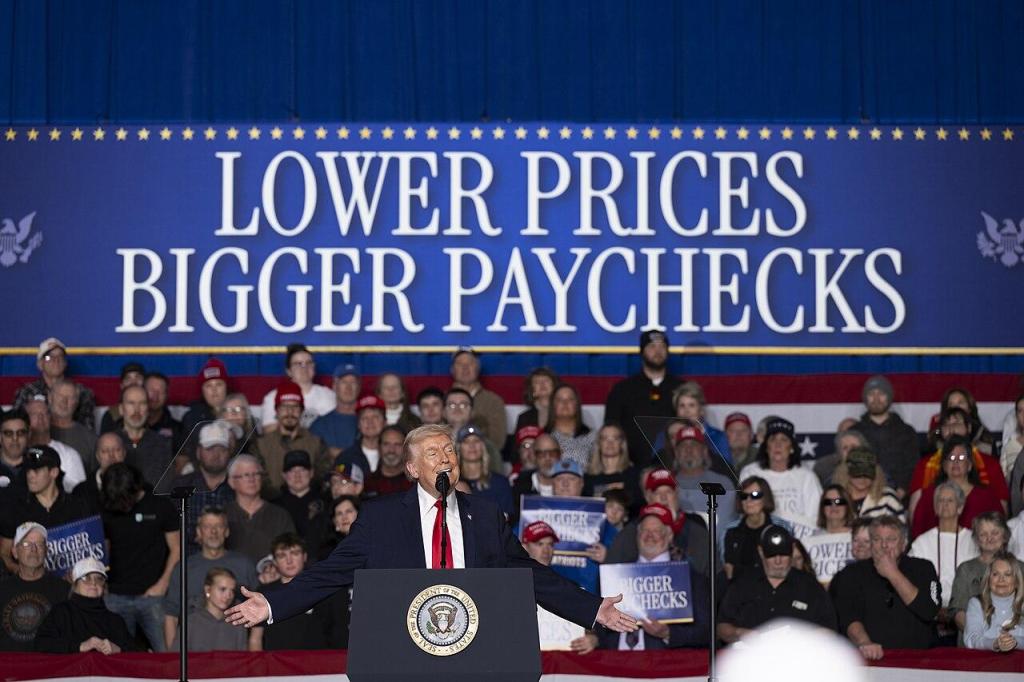
At the Republican midterm convention in Dallas, Trump promised a $5,000 “Trump Dividend” to every adult U.S. citizen if Republicans retain both the House and Senate in November. He also said the money would have to be spent inside the United States.
So Americans have an obvious question:
Why wait until after the election?
Republicans Already Have the House and Senate
This isn’t a hypothetical Republican government waiting to be elected.
Republicans currently hold the Senate majority. The official Senate historical record lists Republicans as the majority party in the 119th Congress, which began with 53 Republican seats. Republicans also control the House.
Trump is president.
Republicans control both chambers necessary to pass legislation.
The Supreme Court has a 6-3 conservative majority, although that fact isn’t directly relevant to issuing checks because the Supreme Court doesn’t write spending legislation.
If Trump’s $5,000 dividend is workable, Republicans currently possess the basic political ingredients needed to introduce legislation and attempt to pass it.
So why make November the starting gun?
Trump Has Actually Been Asked That Question
Trump hasn’t escaped the contradiction unnoticed.
When asked why Americans couldn’t receive the checks now, given current Republican control of Congress, Trump argued that Democrats could not deliver such payments and warned about what would happen if Democrats gained power.
But that doesn’t fully answer the question.
Democrats do not currently control either chamber.
If the money is available now, and the economic conditions supposedly producing it exist now, Americans could reasonably ask why legislation isn’t moving through Congress now.
Trump has said the payments would be possible because of tariff revenue and economic performance.
Yet the numbers present a major obstacle.
$5,000 Checks Would Cost More Than $1 Trillion
There are approximately 245 million adult American citizens.
Multiply that by $5,000 and the price approaches $1.2 trillion.
That is not loose change sitting underneath the Treasury Department’s couch cushions.
Trump has suggested tariffs could help finance the dividend, but FactCheck.org calculated that tariff revenue at recent levels would take more than six years to equal the roughly $1.2 trillion necessary for the checks.
That doesn’t necessarily mean Congress couldn’t finance such payments through some combination of revenue, borrowing or spending changes.
It means Trump’s public explanation has not yet demonstrated where $1.2 trillion would immediately come from.
Congress Probably Has to Approve It Anyway
Trump has suggested congressional authorization might not be necessary.
His own Republican House speaker disagrees.
Speaker Mike Johnson said Congress would need to act before such payments could be distributed. He also identified the central problem: figuring out how to pay for them.
That matters because presidents do not ordinarily possess a trillion-dollar checking account they can distribute however they please.
Congress holds the federal government’s constitutional spending power.
And Republicans currently control Congress.
In other words, if Trump wants lawmakers to authorize his $5,000 dividend, he can ask them to begin doing it right now.
Even Republicans Aren’t All Sold on the Idea
Another wrinkle is that Trump’s own party hasn’t uniformly embraced the proposal.
Recent reporting found that many Republican candidates have avoided campaigning heavily on the $5,000 pledge, while some Republicans have raised concerns about its enormous price tag, inflation and the federal debt.
Former Arkansas Republican Gov. Asa Hutchinson publicly argued that even if Republicans win, GOP leadership should reject the payments and focus instead on reducing the national debt.
That exposes another unanswered question.
Trump isn’t merely promising voters something that requires Republicans to win.
He’s promising something that Republicans themselves would have to agree to enact.
Those aren’t the same thing.
We’ve Heard About Trump Checks Before
Americans also have reason to ask for details because this isn’t Trump’s first proposed dividend.
Trump previously supported the idea of a $5,000 DOGE dividend and later floated tariff rebate checks of as much as $2,000. Neither resulted in universal payments to Americans.
That doesn’t prove the new proposal won’t happen.
It does make skepticism reasonable until there is actual legislation, a funding mechanism and enough congressional support to enact it.
A campaign-stage promise is one thing.
A bill sitting on the House floor with $1.2 trillion attached to it is something else entirely.
The Timing Makes the Promise Political by Definition
Trump didn’t simply announce:
“We have enough money, so Americans are getting $5,000.”
He explicitly connected the payment to the outcome of the November congressional elections.
Republicans retain the House and Senate, Americans get the dividend.
That makes the proposal part of Trump’s midterm political pitch, regardless of whether the policy eventually becomes law.
And voters can evaluate that pitch using a very straightforward set of questions.
Where is the legislation?
Where does the $1.2 trillion come from?
Which Republican lawmakers have committed to voting for it?
Why isn’t Congress debating it now?
And most importantly:
If Republicans controlling Washington after November makes $5,000 checks possible, what specifically prevents Republicans controlling Washington before November from trying to pass them?
Until those questions receive concrete answers, the $5,000 Trump Dividend remains exactly what it currently is:
a campaign promise, not a check.
—Kerry Hill, B1Daily




Leave a comment