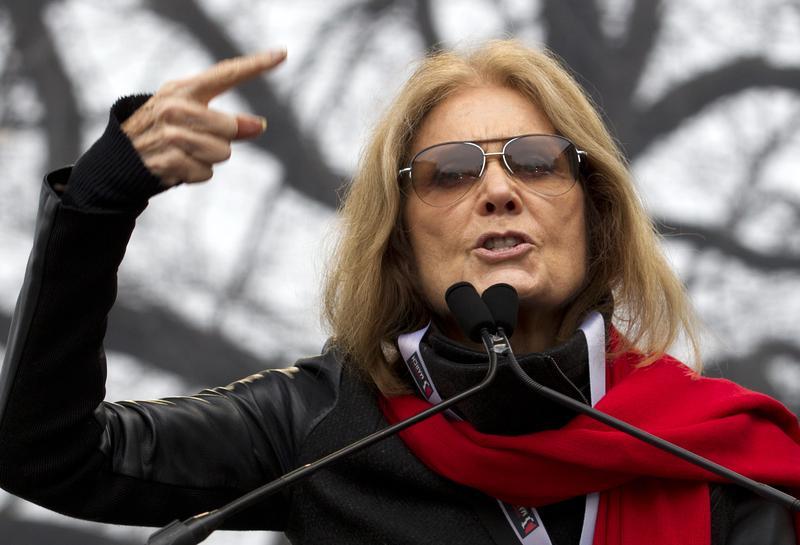
—Barrington Williams, B1Daily
Gloria Steinem is being buried beneath an avalanche of praise, with political figures and media institutions polishing her legacy until practically nothing uncomfortable remains visible. She was unquestionably one of the most influential figures in modern American feminism, co-founding Ms. magazine and spending decades pushing women’s rights into the center of American politics.
But Black Americans are under no obligation to participate in anybody’s canonization.
Steinem built her reputation demanding that America recognize prejudice, stereotypes and institutional power when they harmed women. Yet when race and sex collided, particularly where Black men were concerned, that celebrated sensitivity could become remarkably selective.
That contradiction deserves more than a polite footnote.
It deserves an autopsy.
Clarence Thomas and the Racial Dimension Feminism Didn’t Want to Discuss
Few episodes illustrate this collision more dramatically than the 1991 confirmation hearings of Supreme Court Justice Clarence Thomas.
Anita Hill accused Thomas of sexually harassing her while they worked together. Thomas categorically denied the allegations. The hearings produced dramatically conflicting testimony, with contemporaneous reporting describing the two accounts as impossible to reconcile.
Steinem firmly supported Hill, and her defense of Hill remains prominent enough to be specifically mentioned in retrospectives of Steinem’s political career.
Hill had every right to make her allegations. They deserved investigation and serious consideration.
But Thomas had rights too.
And Thomas raised something during those hearings that America’s predominantly white feminist establishment should never have been permitted to wave away: the racial history attached to accusations of Black male sexual aggression.
Thomas described the spectacle as a “high-tech lynching,” explicitly arguing that he was being subjected to one of the oldest racist stereotypes Black men have faced in America.
Whatever one thinks of Thomas’s politics, that historical argument cannot simply be dismissed because conservatives subsequently embraced him.
America has an ugly record of portraying Black men as sexually uncontrollable predators threatening women. Those stereotypes were not merely rude caricatures. They helped rationalize segregation, imprisonment, mob violence and lynching.
Yet the political atmosphere surrounding Thomas increasingly became a referendum on whether one believed Hill.
That should trouble anyone claiming allegiance to equality.
An accusation deserves investigation.
An accusation is not a conviction.
A political movement that spends decades teaching America about destructive stereotypes should understand why automatically attaching guilt to a Black man accused of sexual misconduct carries particularly dangerous historical baggage.
The principle should have been simple: listen to Hill seriously, examine the evidence seriously and afford Thomas the same presumption of innocence owed to anybody else.
Instead, Thomas became a symbol.
And once a human being becomes a symbol, nuance tends to get fed into the wood chipper.
Black Men Are Not America’s Designated Villains
This is where portions of mainstream feminism have repeatedly created friction with Black men.
There seems to be endless sophistication available when discussing stereotypes affecting women. Society is correctly instructed not to generalize, not to objectify, not to assume and not to reduce women to ancient prejudices.
Excellent.
Black men deserve the same intellectual courtesy.
America spent centuries constructing the Black male body as something frightening: criminal, hypersexual, violent, primitive and dangerous.
Those stereotypes have consequences.
They influence policing.
They influence criminal justice.
They influence media coverage.
They influence how ordinary people interpret confrontations involving Black men.
So why should those stereotypes suddenly become politically irrelevant whenever the accusation comes wrapped in the language of feminism?
They shouldn’t.
Black men cannot become acceptable collateral damage in somebody else’s liberation movement.
Then Came Barack Obama
If the Thomas controversy exposed one fault line, the 2008 Democratic presidential primary exposed another.
While supporting Hillary Clinton against Barack Obama, Steinem argued that gender was “probably the most restricting force in American life.” She also suggested that a Black woman with Obama’s political résumé would not have been a viable presidential candidate. The remarks angered many Black Americans who believed Steinem was minimizing the enormous historical force of racism.
Think about the political moment.
America had never elected a Black president.
Black Americans remained profoundly underrepresented across numerous institutions of national power.
And during the first genuinely successful Black presidential candidacy in American history, one of America’s most famous white feminists was explaining why gender represented an even greater restriction.
That wasn’t merely politically tone-deaf.
It exposed exactly why some Black Americans have regarded portions of mainstream white feminism with suspicion.
Steinem later argued that racism and sexism were linked and shouldn’t simply be ranked against each other.
But that clarification couldn’t erase the larger problem illuminated by the controversy.
Too often, supposedly universal conversations about oppression somehow arrive at a destination where the experiences of white women occupy the center of the map.
Equality Cannot Have a Racial Escape Clause
This is the contradiction that deserves far more attention in assessments of Steinem’s legacy.
A movement cannot demand that society dismantle stereotypes about women while displaying indifference toward stereotypes about Black men.
It cannot insist that society recognize women’s historical trauma while treating Black male historical trauma as an inconvenient interruption.
It cannot demand nuance for one group and suspicion for another.
And it certainly cannot call that arrangement equality.
Black men have their own history in America.
A brutal one.
From lynch mobs operating under accusations involving white women to wrongful convictions and racialized portrayals of Black male criminality, Black men know perfectly well what can happen when accusation, fear and racial mythology combine.
Acknowledging that history does not require attacking women.
It requires applying the same principles universally.
Protect victims. Investigate allegations. Follow evidence. Punish the guilty. Protect the innocent.
No racial exception.
No gender exception.
No ideological exception.
The Halo Needs to Come Off
None of this erases Steinem’s accomplishments. She helped transform American feminism into a formidable political movement, founded influential institutions and spent decades advocating for women’s equality.
But accomplishments are not indulgences purchased from history.
Steinem demanded that America examine its prejudices.
Fine.
Her politics don’t get an exemption from the examination.
Black Americans should reject the idea that criticizing an icon somehow betrays the larger struggle for equality. Political movements become healthier when their contradictions are exposed, not when their celebrities are embalmed in flattering mythology.
And one contradiction deserves to be carved into the discussion of Steinem’s legacy:
Black men are not acceptable collateral damage in somebody else’s liberation movement.
They do not lose their claim to racial dignity because an accusation fits a politically convenient narrative. Their experiences with racism do not become less legitimate because acknowledging those experiences complicates feminist politics. And the centuries-old stereotype of the dangerous Black male does not magically stop being racist because somebody invoking it considers themselves progressive.
If feminism demands freedom from prejudice, that principle must extend beyond women.
If feminism demands that stereotypes be dismantled, Black male stereotypes belong on the demolition list.
If feminism demands equality, Black men cannot become its convenient exception.
Otherwise, what is being offered isn’t universal liberation.
It’s hierarchy with better branding.
—Barrington Williams, B1Daily



Leave a Reply