—Kerry Hill, B1Daily
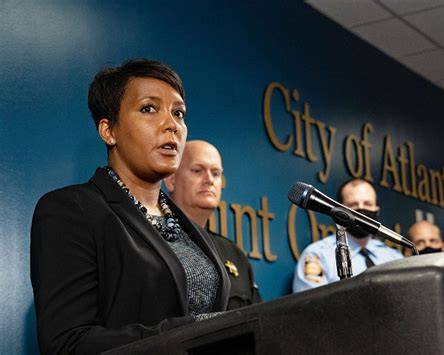
Keisha Lance Bottoms is asking Georgia voters to promote her.
The former Atlanta mayor is now the Democratic nominee for governor, campaigning on her experience running the capital city and promising expanded Medicaid, protections for voting rights, support for small businesses and other statewide initiatives.
For Black voters, however, there should be another question before anyone starts printing history-making bumper stickers:
What did Black Atlanta actually receive when Bottoms already had executive power?
Atlanta is one of the most important centers of Black political, cultural and economic life in America. Bottoms governed a city with a Black political infrastructure that generations fought to create. If that record is supposed to be her résumé for governor, Black voters have every right to inspect the fine print.
And from this columnist’s perspective, the results simply aren’t impressive enough to justify handing her the keys to Georgia.
Somehow, the Police Money Wasn’t Complicated
When Bottoms wanted to increase police compensation, City Hall discovered urgency with astonishing speed.
In 2018, her administration proposed what the city itself called an “unprecedented” 30 percent pay increase for Atlanta police officers over three years. Bottoms signed the legislation, with an additional $10 million initially allocated toward compensation. The first round of raises was delivered ahead of schedule.
Later, her FY2022 budget funded 250 police vacancies, continued police and firefighter raises, and provided money for public-safety infrastructure.
Bottoms now advertises that record herself. During her gubernatorial campaign, she has pointed to police and firefighter raises and her support for the public-safety training center as evidence that she has a “very strong record” on public safety.
Fine.
But that makes the contrast even more glaring.

When police wanted resources, there was legislation.
There was money.
There was a timetable.
There was implementation.
There was a mayor willing to put her political capital behind it.
Where was that machinery for reparations for Black Atlantans?
Reparations Could Apparently Wait
Bottoms served as mayor from 2018 through 2021.
Yet Atlanta’s formal Reparations Study Commission came later. The Atlanta City Council appointed members to the commission in 2025 to research the city’s role in legal discrimination against African Americans and recommend possible remedies for resulting economic, educational, health and social disparities.
That chronology deserves attention.
Atlanta had a Black mayor, a Black political establishment and one of the richest Black historical legacies of any American city. Yet Bottoms did not leave office having established the reparations machinery that Atlanta is only now operating.
This is precisely the kind of political disconnect Black voters should interrogate.
Apparently a 30 percent police pay increase could become an urgent mayoral priority.
Reparations could become somebody else’s project.
That doesn’t mean Bottoms accomplished nothing for Black residents. Her administration pursued cash-bail reform for city ordinance violations, stopped the city jail from accepting ICE detainees, expanded diversion initiatives, began efforts to close and reimagine the Atlanta City Detention Center and implemented other criminal-justice reforms.
Those accomplishments deserve acknowledgment.
But they don’t erase the question.
Atlanta’s Black population didn’t merely need symbolic representation or generic progressive policy. It faced enormous disparities involving housing, wealth and displacement.
A mayor governing such a city should be judged by whether Black political representation translated into material Black advancement.
Black Atlanta Was Still Being Squeezed
Housing provides another uncomfortable part of the record.
Bottoms did make affordable housing a significant part of her agenda, including appointing Atlanta’s first chief housing officer.
But even during her administration, critics argued that City Hall wasn’t doing enough about gentrification and affordable housing in a city suffering extraordinary income inequality.
That matters because Atlanta’s transformation isn’t an abstract urban-planning seminar.
Historically Black neighborhoods have faced enormous development pressure. Rising property values can enrich homeowners, but they can also produce higher rents, taxes and displacement pressures for residents who don’t share equally in the new wealth.
The political standard therefore cannot simply be:
Did Atlanta grow?
Atlanta was going to grow.
The question is:
How much of that growth translated into durable wealth and security for the Black population that helped build Atlanta’s identity in the first place?
Ribbon cuttings aren’t reparations.
Development isn’t automatically racial equity.
And having a Black mayor doesn’t automatically mean Black residents are receiving a Black economic agenda.
Representation Is Not a Policy
This is where Black voters should become considerably less sentimental about political firsts.
Bottoms could become the first Black governor of Georgia. That would unquestionably be historically significant.
But Black voters have been supplying politicians with historic victories for a very long time.
At some point, history needs to start paying dividends.
Black representation has value. Children seeing Black governors, senators, judges and presidents has cultural importance. But representation becomes politically hollow when voters are expected to celebrate who occupies the office without aggressively examining what that person does with the office.
Black voters should be especially skeptical of politicians who suddenly discover highly specific promises when election season arrives.
Bottoms currently proposes a Georgia voting-rights law modeled around protecting ballot access and preventing vote dilution, an issue with obvious importance to Black Georgians.
Good.
Now apply the same standard everywhere else.
Where is the aggressive Black wealth agenda?
Where is the commitment to closing racial disparities in homeownership?
Where is the statewide strategy for historically Black neighborhoods threatened by displacement?
And, yes, where does reparations for descendants of American slavery fit into the agenda?
Those aren’t fringe questions for a politician asking Black voters to provide the electoral muscle necessary to put her in the governor’s mansion.
They should be entrance-exam questions.
Black Voters Shouldn’t Be an Electoral ATM
Democratic politicians understand the mathematics of Georgia.
They know Black voters are indispensable to any realistic Democratic coalition.
That political importance should translate into leverage.
Black voters shouldn’t operate as an electoral ATM where politicians insert a campaign card every four years and withdraw enormous turnout while depositing vague promises about “equity” and “opportunity.”
Votes are political currency. Demand something for them.
Bottoms’ defenders can legitimately point to criminal-justice reforms, pandemic leadership, balanced budgets and other accomplishments. Her administration also survived an extraordinary period encompassing COVID-19, protests after George Floyd’s murder, the police killing of Rayshard Brooks and a national spike in violent crime. Any assessment pretending she governed during ordinary circumstances would be dishonest.
But difficult circumstances don’t exempt a politician from scrutiny.
They’re exactly why résumés matter.
Bottoms herself calls her experience “battle-tested.”
Then test it.
Georgia Governor Should Not Be a Political Promotion
This opinion page’s conclusion is straightforward:
Keisha Lance Bottoms has not demonstrated enough from her tenure as Atlanta mayor to deserve automatic Black support for governor.
Not because she’s a Black woman.
Not despite being a Black woman.
Because Black voters should evaluate Black politicians using the same hard political arithmetic they should use on everybody else:
What did you deliver?
Bottoms proved she could mobilize government resources when something became a priority. Her administration delivered an unprecedented police compensation package, pursued additional police hiring and supported what eventually became Atlanta’s public-safety training center.
So Black voters are entitled to ask why equally muscular government action wasn’t deployed toward reparations during her mayoralty.
They are entitled to ask whether Atlanta’s economic boom sufficiently benefited its Black working and middle classes.
They are entitled to examine whether her policies matched the enormous Black political capital invested in Atlanta City Hall.
And they are entitled to withhold support if the answers aren’t good enough.
The gubernatorial election shouldn’t be a coronation based on biography.
Atlanta already gave Keisha Lance Bottoms executive power once.
Before Black Georgia gives her substantially more of it, voters should examine what happened the first time and demand something more substantial than history, symbolism and another campaign promise.
Because Black political power isn’t measured by the complexion of the person holding the office.
It’s measured by what Black communities have to show when that politician leaves it.
—Kerry Hill, B1Daily


Leave a Reply